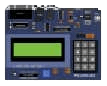
Arduino Mega and Franzininho DIY in PICSimLab: ATmega2560 and ATtiny85
PICSimLab’s AVR line-up has a big board and a tiny one. The Arduino Mega runs the ATmega2560 — the largest AVR in the simulator — while the Franzininho DIY runs the little ATtiny85 and brings a piece of Brazilian open-source hardware into the board list. Both run on the simavr backend.
Overview
The Mega is the board to pick when an Uno-class chip is too small for the project you are practising: more flash, more pins, the same Arduino workflow. The Franzininho DIY is the opposite end of the scale — a small ATtiny85 board from the Franzininho open-source hardware project (Brazil), made for simple, cheap, solder-it-yourself electronics education. PICSimLab models both so the projects can be rehearsed in simulation first.
Supported MCUs
| Board | Microcontroller | Backend |
|---|---|---|
| Arduino Mega | ATmega2560 | simavr |
| Franzininho DIY | ATtiny85 | simavr |
Backend & debugging
Both boards use simavr, so both get its two debugging routes: MPLAB X Integrated Debug through the PICSimLab plugin, and remote avr-gdb debugging — enable debug in the configuration window, launch avr-gdb with your .elf and connect to localhost:1234. For AVR boards the Code Project Wizard generates VSCode + PlatformIO projects (Arduino framework templates exist for both the Mega and the Franzininho), and Arduino IDE programming is covered in the official documentation as well.
What you can do
- Practise Mega-sized Arduino projects — multi-serial, many-pin designs — before committing to hardware, with spare parts wired to the pins your design uses.
- Prototype Franzininho DIY lessons and tiny ATtiny85 projects (indicators, simple controls, classroom exercises) entirely in simulation.
- Step through code with avr-gdb or MPLAB X on either board, and inspect signals with the oscilloscope module.
- Use the virtual serial ports when a Mega sketch exchanges data with a program on your PC.
Real limits
- The Mega caveat is real: simavr’s upstream documentation describes its AVR core as stable for parts with up to 128 KB flash and only preliminary for bigger parts. The ATmega2560 is a 256 KB part, so it sits in that preliminary zone — expect the Uno/Nano-class support to be the most battle-tested, and verify Mega-specific behaviour carefully.
- The ATtiny85 is a small chip by design: Franzininho projects are intentionally simple, and the board does not turn it into something bigger.
- These are the only two boards of their kind in PICSimLab — there is no ATmega32U4 (Leonardo) or other Arduino variant in the official board list; the remaining AVR boards are the Uno and Nano and the dual-backend Breadboard.
- As everywhere in PICSimLab, there is no built-in source editor; editing happens in PlatformIO/VSCode, the Arduino IDE or MPLAB X.
Both boards are included in PICSimLab itself — grab it from the download page and select Mega or Franzininho DIY from the board list.